
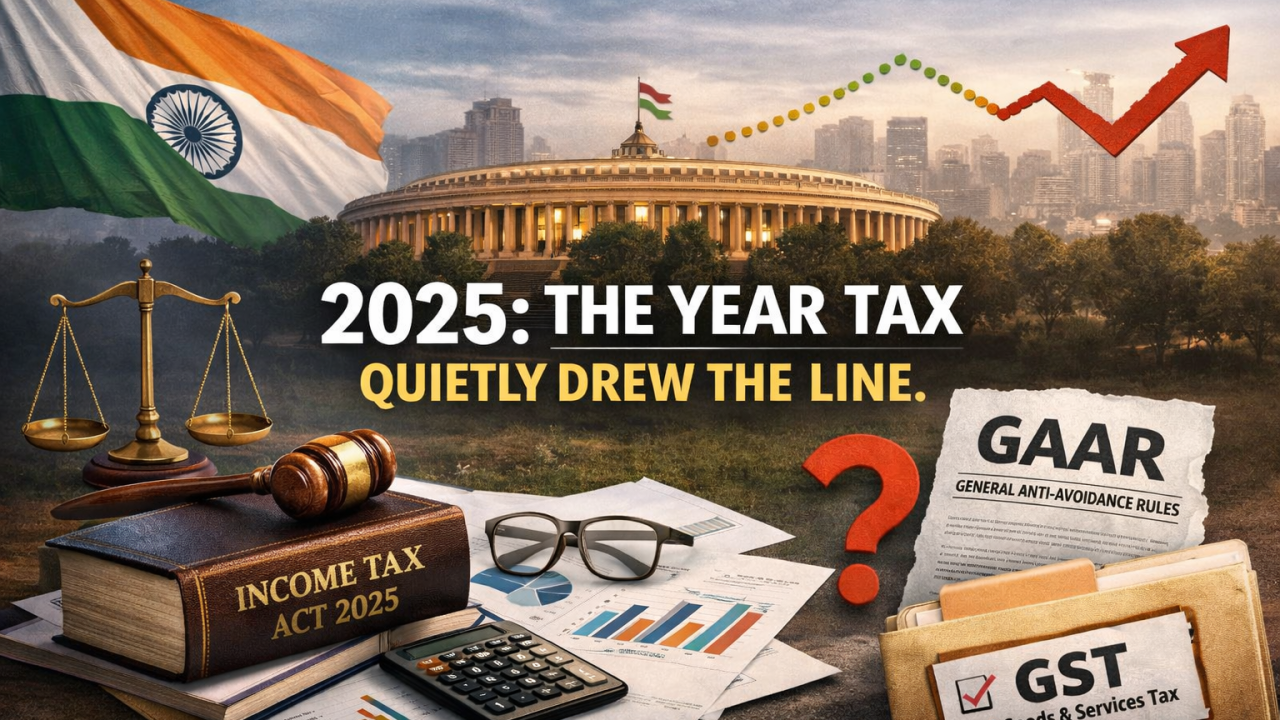
I was reflecting over the past year and realised that 2025 didn’t really give us any big tax shocks. No loud announcements, no dramatic changes. And yet, from where I sit, it quietly changed the way the system thinks and behaves.
If you look at 2025 through headlines alone, it feels uneventful. No big rate changes. No dramatic announcements. No overnight surprises that forced everyone to rework models.
But for those running tax inside companies, 2025 was not uneventful at all. It was the year the system quietly changed its attitude.
The Finance Act, 2025 came and went without noise. And that itself said a lot. Instead of trying to impress, it did something more serious, it tightened things. Definitions became clearer.
Computation rules left less room for interpretation. Long-standing grey areas began to shrink. The message was subtle but firm. If a position survives only because the law is complicated, its days are numbered.
Around the same time, the Equalisation Levy on online advertising was withdrawn from April 2025. This looked like a small change, but for multinational groups it mattered. Not just for cost, but for clarity. One less India-only adjustment to explain to global headquarters. One less friction point in cross-border discussions. It felt like India was saying, “We’ve made our point. Let’s move forward.”
GST also started behaving differently. It didn’t become simple overnight, but by September 2025, the intent was visible. Rates were rationalised. Slabs were trimmed. The real relief wasn’t the tax saved—it was the possibility of fewer classification disputes and fewer arguments over things that never should have been arguable. For businesses, that matters more than any rate cut.
The courts played their part too, and they did so without drama. In GST cases, the message was clear, genuine buyers shouldn’t suffer just because someone else defaulted. Practical reliefs like allowing mandatory pre-deposits to be paid through the credit ledger, showed that commercial reality was being recognised. At the same time, courts were not willing to stretch the law just because a business story sounded reasonable. Caps meant caps. Conditions meant conditions.
GAAR also came back into conversations in 2025 and this time it made people uncomfortable. Not because it was new, but because of where it was being tested. Tax officers tried to stretch GAAR into areas that looked like ordinary market behaviour, especially capital loss situations. The courts pushed back. The message was important, GAAR is a serious weapon, not a shortcut. You can’t invoke it just because the timing looks convenient or because the tax outcome doesn’t feel right. At the same time, no one should assume GAAR is toothless. As data improves and patterns become easier to spot, genuinely engineered structures will attract closer attention. The line is getting clearer, but also sharper.
Perhaps the biggest change in 2025 was in how the tax department behaved. There were more nudges and fewer blunt actions. Systems flagged mismatches early. Taxpayers revised returns not out of fear, but because the inconsistency was obvious. This changes expectations. Today, it’s not enough that a position is technically arguable. It has to be clean, consistent, and easy to explain.
And quietly sitting in the background through all of this was the Income-tax Act, 2025, coming into force from 1 April 2026. A full replacement of the 1961 law is not cosmetic. It’s a reset. Simpler drafting will remove many hiding places. The law may read easier, but weak positions will stand out faster. FY 2026–27 will be a starting line, not just another year.
That’s what 2025 was really about. The system stopped debating and started expecting better behaviour. Less noise. Less tolerance for games. More focus on substance and consistency.
Nothing exploded in 2025.
And that’s exactly why it mattered.
Leave a Reply